One Yaku Short
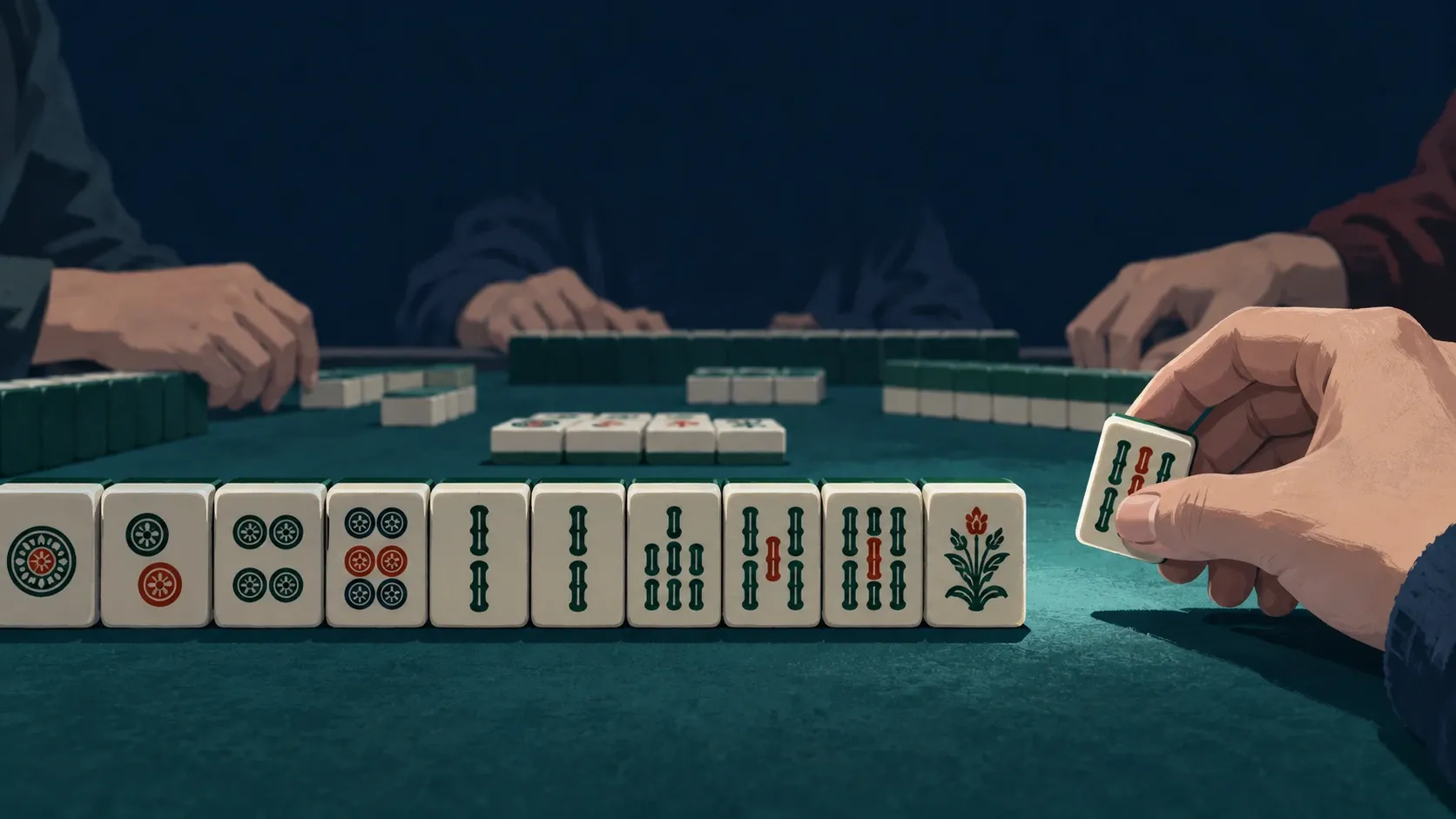
The first thing anyone tells you about mahjong is the sound. A full set of tiles, shuffled face down on a table, makes a noise somewhere between rain on a car roof and a drawer of cutlery being emptied very slowly. The name of the game is usually traced back to a word for sparrow, and you can hear why. It chatters.
I mention the sound because it’s the part people already like. They hear it in a film, or walk past it in a restaurant, and something in them leans toward the table. Then they sit down, and most of them never sit down again.
That’s the part I keep turning over.
Where I learned.
I came to riichi from two directions at once, and neither of them was a rulebook.
The first was Akagi, an anime about a thirteen-year-old who walks into a mahjong parlour soaked from the rain and starts beating gangsters at their own table. Everyone in it has a chin you could open letters with. Whole scenes pass with people sweating over a single discard while the word zawa crawls across the screen like static. I understood almost none of the hands. I understood completely that the discard mattered, and that setting one tile down on the felt could be the most dangerous thing a person did all night.
The second was a sushi restaurant where I worked. The owner played, and so did the owner’s son, and between the two of them I picked up everything the anime skipped. Which tiles were safe to throw. Why a hand that looked finished could be worth nothing. They didn’t explain much. They’d glance at my discards, then at each other, and one of them would laugh. Slowly I started to see what they were seeing.
The anime made me want to sit down. The restaurant is why I kept sitting down.
Rummy on the surface.
On paper, mahjong should be everywhere. The core of it is rummy, which most of us learned from a grandparent. You draw a tile, you discard a tile, you’re trying to arrange thirteen tiles into sets so that the fourteenth completes the hand. Runs and triplets, plus a pair. A child can follow that in ten minutes.
And the depth underneath it is enormous. Riichi, the Japanese version I was taught, asks you to build your own hand while reading three other people as they build theirs. Neither half works without the other. Every discard goes face up into a little grid in front of the player who threw it. After a dozen turns, each discard pile is a kind of diary. This person is shedding everything near the five of bamboo. That one has been throwing safe tiles for three turns, which means they’re frightened of somebody. You start to see the hand behind the hand.
Raph Koster argues in A Theory of Fun that games die when we finish learning them. The brain grasps the pattern, files it away, and gets bored. The more closed and formal a game is, the sooner that happens. The ones that last tend to let something messy in from outside: luck, physics, other people’s moods. Mahjong lets them all in. Chess has no dice. Poker has no structure to build. Mahjong sits in the gap between, and it has been sitting there, mostly unchanged, for over a century.
So it isn’t the ceiling. Something is wrong with the floor.
The game won’t let you win.
Here is the moment, I think, where riichi loses most of the people who try it.
You’ve played a few hands. You understand runs and triplets. You draw a tile that finishes your hand, every set complete, and you go to declare the win. The game won’t let you.

An example of a hand with no yaku.
Your hand needs a yaku, a named scoring pattern from a list of around forty, and this has none. It’s complete and it’s worthless. There’s no partial credit. You just discard and keep going, and someone across the table wins with a hand that looks, to your eyes, exactly like the one you had.
The hand above is a common way to get there. Earlier, someone threw away a seven of circles and you called it to finish your triplet. It felt like progress. But calling a tile opens your hand, and an open hand gives up most of the yaku a closed one could have claimed, including the simplest one: winning on your own draw. What’s left is three runs, a triplet and a pair. Every set is legal. None of it is on the list.
There’s a second rule waiting behind that one. If you’re one tile from winning and a tile you need is sitting in your own discard pile, you can’t win off anyone else’s discard. It’s called furiten. It makes perfect sense once you know why it exists. The first time, you only find out about it because the win you were waiting for never comes.
Then there’s the scoring. Hands are measured in han and fu, two units that multiply through a formula with rounding steps and lookup tables. I’ve played for a long time now, and I couldn’t calculate fu at a real table if you paid me. Almost nobody can. The apps do it, and we trust them.
Building a hand while reading the table is the challenge in mahjong. It’s the beautiful part. But a beginner spends all their attention before they get there, on a vocabulary list and an arithmetic problem. By the time they could start noticing that the player to their left is frightened, they’re tired.
Celia Hodent, in The Gamer’s Brain, describes something called the curse of knowledge. Once you know a game, you can’t unknow it, and you lose the ability to see where it’s hard. Every experienced riichi player I’ve met says the same thing to new people: just play, you’ll pick it up. That’s true. It took me months. Most people don’t give a hobby months on the strength of a sound.
The rules expire every April.
American mahjong has a different wall, and it’s stranger.
The hands you’re allowed to make are printed on a card issued by the National Mah Jongg League, and the card changes every spring. Last year’s winning hands may not count this year. You buy the new card, unfold it, and relearn part of your own game. There are jokers, which riichi doesn’t have, and a ritual at the start called the Charleston where everyone passes tiles to their neighbours in a set sequence. I find it charming. I can also imagine explaining “the rules expire annually” to a friend and watching their face.
Neither version helps itself with the name, either. Ask most people in the West what mahjong is and they’ll describe a solitaire game where you click matching tiles off a pyramid. It came installed on a lot of office computers. It has nothing to do with the real thing, and it got there first.
And then there’s the plain fact of the chairs. Mahjong needs four people. Not two to four. Four. Board games learned a long time ago that a flexible player count is half of what gets a box off the shelf. Mahjong will sit unopened in a cupboard for a year because one friend couldn’t make it on Thursday.
The fourth chair.
What complicates all of this is that the game has never needed to be easy to last. American mahjong has been played for close to a century by rooms full of people teaching each other. Someone hosts, someone else brings the set, and the teaching happens across the table, from people who are patient because they want you back next week. The card still changes every April. The fourth chair gets filled because somebody goes and fills it.
This spring, nobody can. The new card arrives this month into a world where four people can’t share a table, and I keep thinking about all the sets sitting closed in cupboards, waiting for that to change.
Riichi has a partial answer. Tenhou and Mahjong Soul will match you with three strangers at any hour and do every bit of the scoring for you, which quietly removes half the problems above. But Mahjong Soul comes dressed in the look of a gacha game, all sparkle and character skins, and I’ve seen friends close it before the first hand loaded.
So I still don’t fully understand it. I think the game is one of the best ever designed. I think it asks too much of you on the first night. Both of those are true at the same time, and I’m not sure they can be fixed by changing a rule.
Somewhere tonight four strangers in four different houses are waiting on the same shuffle. One of them is new, and doesn’t know what a yaku is, and is about to draw the tile that finishes their hand.