Understanding New Player Experience
My notes here are all from my time working in the video game industry on a title that has been alive and profitable for years while keeping its player-base mostly satisfied.
Working on an ongoing free to play video game in 2018 means updating often and keeping people entertained. The carrot on the stick needs to always be there. This could be in the form of many things. In the chaos of updating frequently while trying to maintain quality some things make it live before they’re ready. In some cases overlooked, but not intentionally.
In this case it was the experience new players were having on the game. The veterans were used to the lack of information in game and constant need to look items up on the wiki. The new players were confused and overwhelmed. So how do we identify this confusion?
Don’t overthink it. Just ask your player base.
What were some things you wish the game taught you in the first 2 hours? Were there some things that were too overwhelming or confusing during these first 2 hours? From my experience leaving this question open ended results in better data.
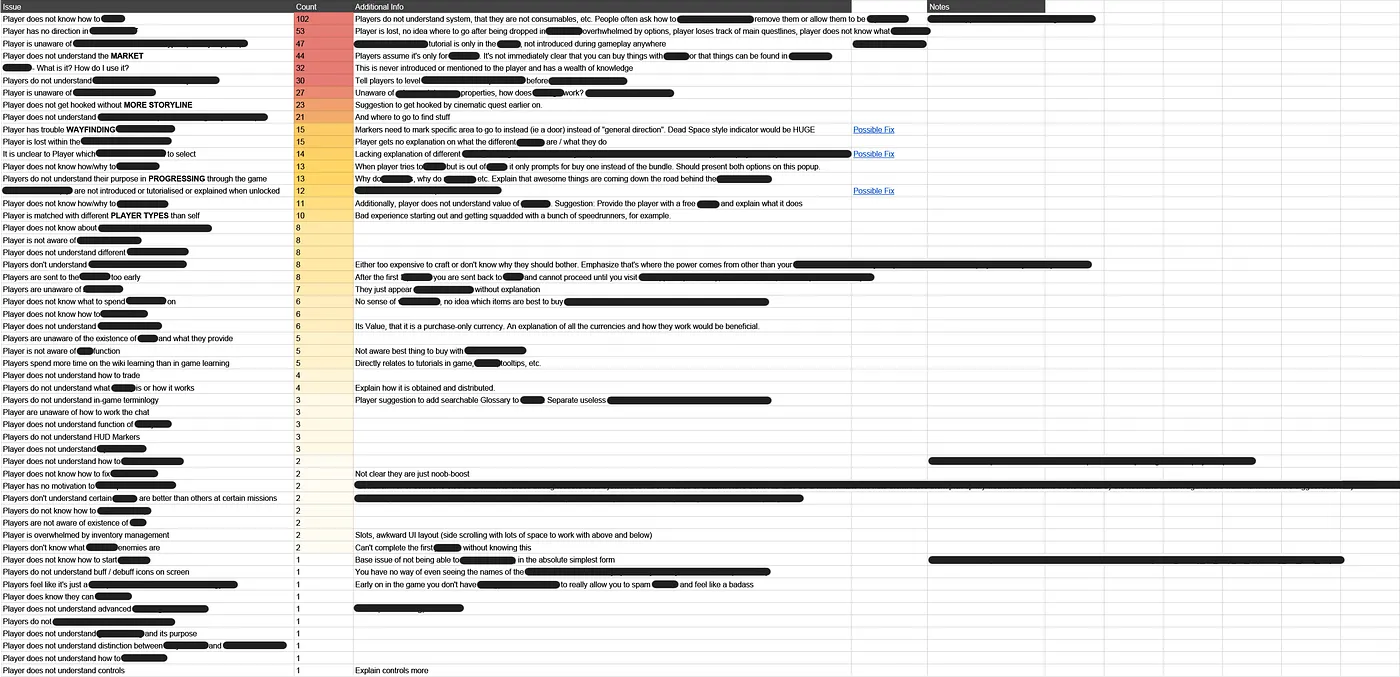
Results from our new player experience survey.
Alternatively you can create a new account as if you were playing it for the first time. Seriously, try it. Do you have a tutorial? If you do it should explain enough to get the player started but not overwhelm. Teach the basics and hold the rest until later. Advanced combat and world travel should be taught when appropriate. Pacing is key.
In the above example we were clearly overwhelming new players.
What are the friction points? This is where the above two approaches, survey and starting a new account, come in handy. If we’re going to make some changes we should do so with all the feedback we can get both internally and from the community.
Our research told us the problem was happening after the first quest ended. We dropped players into an open world game with no guidance. We didn’t tell players their next goal and left complex mechanics unexplained. There was even a specific screen that if opened immediately following the quest that player would leave and never return. The data team are your best friends here.
Being a long time player of their game prior to being hired I compiled a list of possible fixes. There were small fixes and big ideas for fixing this problem. We could shift the second and third quest up one point on the progress path so players are invested and have a clear goal early on. We could give the player a reward that requires mechanic interaction.
Crafting is a good example of this.
“Oh looks like you’ve found X item! Now is a good time to explain how you craft with that item. Here’s a quick explanation and example.” Have the player do the interaction. Don’t show them in a video. By having the player do this themselves you start building muscle memory. If done well it will feel like riding a bike when coming back to it.
After thinking through all the approaches we could take I talked through my solutions with game design and made my suggestion. We had a long discussion about the impact this solution would have. After which we decided to test two of the approaches.
We put the two changes on our test server and asked our testers and community to try it. The feedback we received was mostly positive, but there were some unexpected concerns raised. This is why it’s important to keep questions open ended. Once all the issues were ironed out we pushed the solution live.
After a few months we looked at the numbers again and compared to before. The data told us the friction point was now after quest 8. That allowed us 7 more missions (~3 hours of game-play) to convert a beginner to a fan. Our first impression became much clearer.
You could have the most exciting game-play loop in the industry, but if new players are quitting or uninstalling before you can show them that game-play loop then you’re losing before you’re given a fair chance.
The numbers dictated that we had an increase in user acquisition and engagement. New players felt more comfortable with the experience so they spent longer on the game.
Everybody wins.